
Whether you own or operate a single truck or a fleet, having truck service ramps as part of your standard garage equipment makes it easier to take care of simple maintenance in-house.
Why choose service ramps over jack stands?
Truck ramps provide the lift and the stand all in one easy-to-use design. The over-engineered construction of HD Ramps' aluminum truck service ramps makes them safer than traditional jack stands, and they're made in America so that you know you're getting quality materials manufactured stateside.
All jack stands, whether manufactured overseas on in the United States, carry the risk potential for failure, which in turn can create a liability for personal injury as well as damage to fleet or work vehicles.
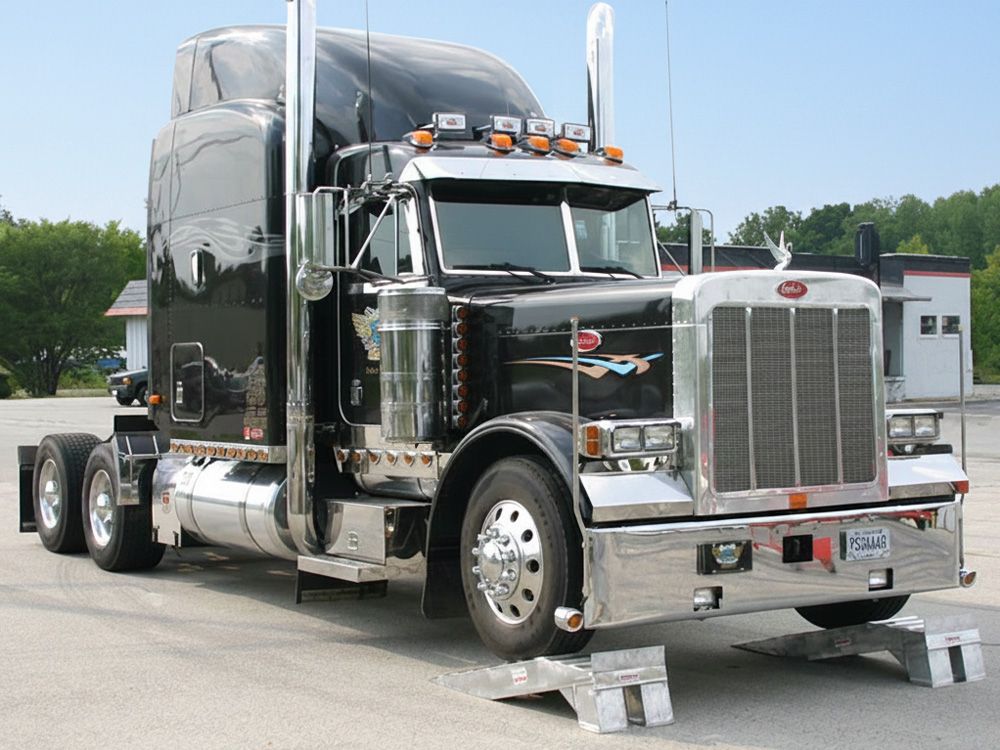
Truck oil change ramp features to look for
- Ramp width: Should be wide enough to fit the largest commercial tire that's in your fleet with at least an inch or two on both sides. The average box truck, pickup truck or utility truck tires might be 8" +, and larger commercial truck and semi-truck tires are likely to be 11"+.
- Lift height: Look for lift heights around 9" or more to ensure you have enough room to maneuver.
- Approach angle: Should be between 10 and 15 degrees, no steeper or the weight on the heavy-duty tires runs the risk of slipping, or sliding the ramp forward. For low-profile trucks that have low clearance or front spoilers (like the Freightliner Cascadia series), HD Ramps manufactures an extra-long Class A service ramp with a 4.4 degree incline to mitigate scraping on the ramp entry.
- Material & construction: Steel or aluminum are your safest bets, however Race Ramps does make a heavy-duty service ramp out of their proprietary solid core foam.
- Weight capacity: Know the Gross Axle Weight Rating (GAWR) and Gross Vehicle Weight (GVW) of your largest fleet vehicle.
Understanding truck weight ratings
- Gross Axle Weight Rating (GAWR): This rating is set by the manufacturer to define the amount of weight a single axle can support. The front GAWR and rear GAWR can differ.
- Gross Vehicle Weight Rating (GVWR): This rating is set by the manufacturer to define the amount of overall weight the vehicle can support, including all occupants and cargo.
Examples:
- A Ford F-250 pickup truck might be rated for 6,340 lb rear GAWR / 10,500 lb. - 11,500 lb GVW depending on add-ons.
- A standard class 8 semi-truck might have a front GAWR of 12,000 to 14,600 lb.
Where to find truck rating information: GAWR and GVWR can be found on the Federal Certification Label on the driver's side door frame, or in the owner's manual.
Truck classifications based on GVWR
| Class | GVWR (lbs) | Tire Width | Use |
| 1 | Up to 6,000 | 215-285mm (8.5" - 11.2") | SUVs, compact pickup trucks |
| 2 | 6,001 - 10,000 | 215-285mm (8.5" - 11.2") | Vans, fullsize pickup trucks |
| 3 | 10,001 - 14,000 | 225-275mm (8.8" - 10.8") | Dually pickup trucks, small box trucks |
| 4 | 14,001 - 16,000 | 225-275mm (8.8" - 10.8") | Standard box trucks, small dump trucks |
| 5 | 16,001 - 19,500 | 225-275mm (8.8" - 10.8") | Large box trucks, bucket trucks |
| 6 | 19,501 - 26,000 | 225-275mm (8.8" - 10.8") | beverage trucks, single-axle dump trucks |
| 7 | 26,001 - 33,000 | 295mm (11.6") most common - 385 (15.1"), 442 (17.4"), 445mm (17.5") | city buses, garbage trucks |
| 8 | 33,001+ | 295mm (11.6") most common - 385 (15.1"), 442 (17.4"), 445mm (17.5") | tractor-trailers/big rigs/18 wheelers |
Prioritizing safety first when working on trucks
Safety is non-negotiable when working on semi-trucks. Following key guidelines is critical to keep you and your team safe and ensure every maintenance job goes smoothly.
- Always park trucks on a flat, stable surface before using ramps.
- Double-check that the ramps are rated to handle your vehicle''s weight and tire size. Inspect ramps for cracks or damage before each use, and never exceed the stated capacity.
- Make sure wheels are straight and properly aligned with the center of the ramp, leaving at least one inch of clearance on each side of the tire.
- Chock the rear wheels on the ground and set the parking brake. Only begin work once you confirm the truck is solidly supported and doesn't rock or shift.
- Always wear proper gear and stay clear of moving parts when underneath a lifted truck


